


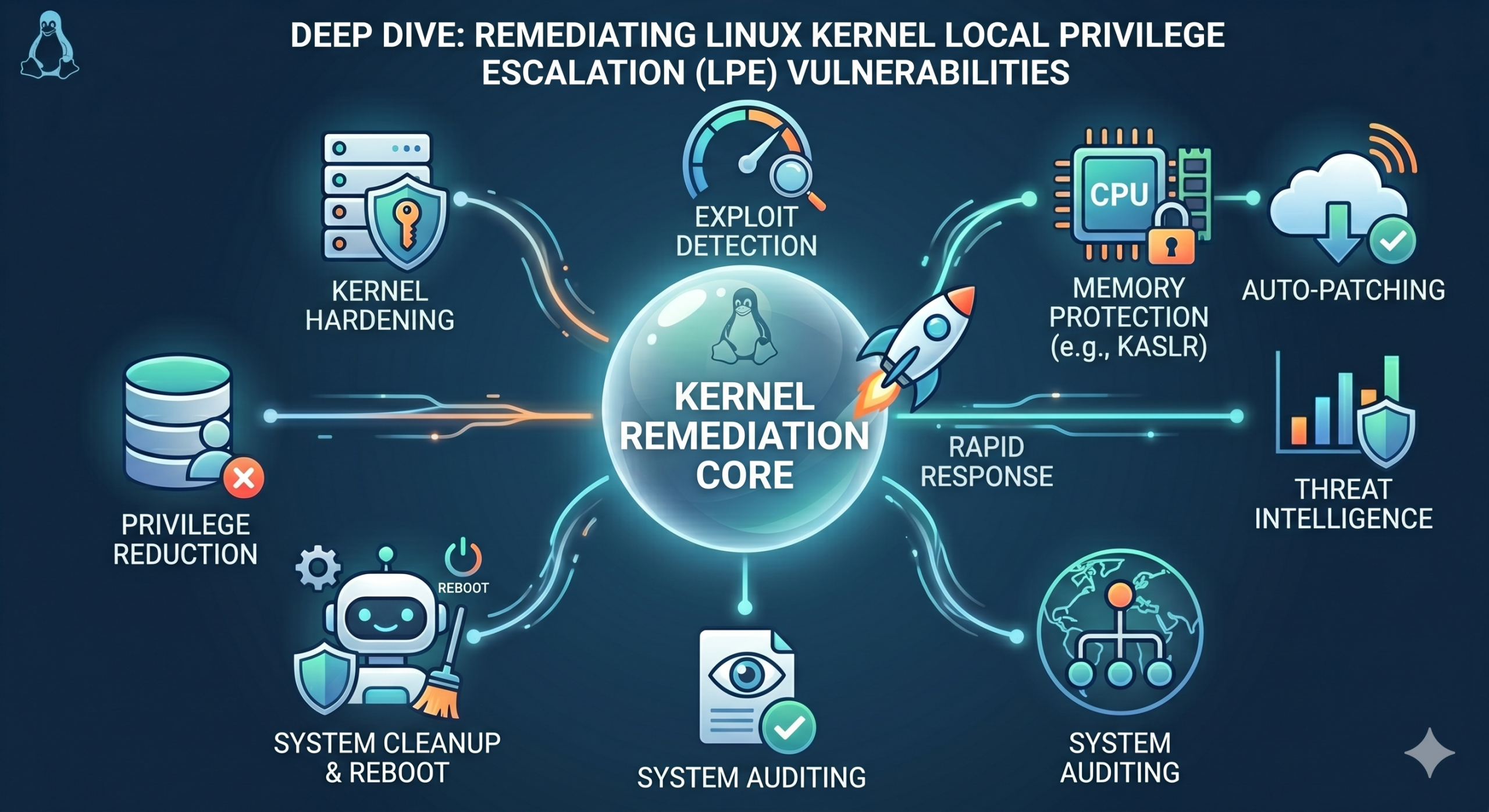
Understanding Modern Kernel-Level Threats
Local Privilege Escalation (LPE) vulnerabilities, such as those targeting the Linux kernel (e.g., vulnerabilities within io_uring or netfilter), pose an existential threat to shared hosting environments. An attacker who gains a low-privileged shell can leverage these bugs to obtain root access, bypassing containerization provided by CloudLinux or standard chroot environments.
1. Vulnerability Assessment and Kernel Auditing
The first step in protecting your infrastructure is identifying the current kernel version and cross-referencing it with the latest security advisories from the Linux Kernel Archive and your specific distribution (e.g., RHEL/AlmaLinux/Ubuntu).
Check your current kernel version:
uname -r
For enterprise environments, it is critical to use tools like kpatch to apply security fixes without requiring a system reboot, ensuring 100% uptime for hosted services.
2. The Role of CloudLinux in Mitigation
If you are running a multi-tenant hosting environment, standard Linux kernels are insufficient. CloudLinux provides the KernelCare service, which automates the patching of vulnerabilities at runtime. To check if your server is protected against the latest CVEs, use:
kcarectl --info
3. Securing the Kernel via Sysctl Hardening
Hardening the kernel parameters can reduce the attack surface for privilege escalation. Edit your /etc/sysctl.conf to restrict unprivileged access to kernel interfaces:
# Restrict unprivileged eBPF access to prevent exploits
kernel.unprivileged_bpf_disabled = 1
# Disable kernel pointer exposure via dmesg
kernel.dmesg_restrict = 1
# Restrict access to perf events
kernel.perf_event_paranoid = 3
Apply these changes immediately with sysctl -p. These settings prevent attackers from leveraging standard kernel profiling tools for side-channel or exploit-based reconnaissance.
4. Incident Response and Patching Workflow
When a zero-day is announced, follow this operational workflow:
- Isolate: Move suspicious user accounts to restricted containers.
- Monitor: Utilize
auditdto monitor suspicious system calls. - Deploy: Update the kernel package via your package manager (e.g.,
dnf update kernelorapt upgrade). - Validate: Perform a reboot or apply a live-patch.
Conclusion
Securing the Linux kernel requires a proactive, layered defense strategy. By combining kernel-level hardening, utilizing live-patching solutions like KernelCare, and maintaining a rigid system call monitoring policy, you significantly raise the cost of an exploit for any potential attacker.
