


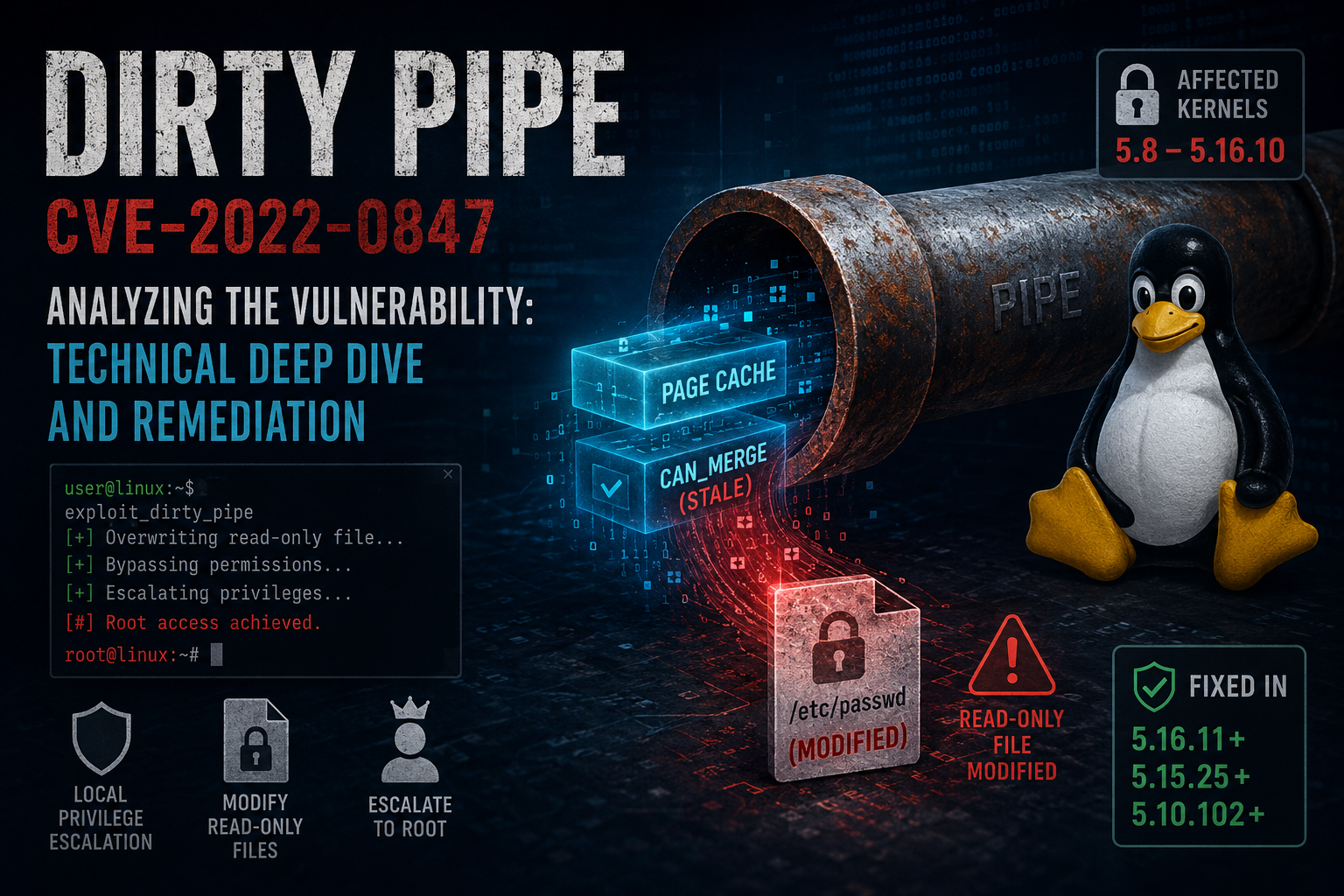
The Anatomy of CVE-2022-0847
The ‘Dirty Pipe’ vulnerability is a classic example of a flaw in the Linux kernel’s pipe buffer management, allowing an unprivileged user to overwrite data in read-only files. This effectively leads to local privilege escalation (LPE) to root access, making it a critical threat to any multi-tenant hosting environment.
Understanding the Mechanism
The issue stems from the way the kernel handles pipe page flags when copying data. An attacker can inject arbitrary data into the page cache of a file, even if they lack write permissions to that file, by manipulating the PIPE_BUF_FLAG_CAN_MERGE flag. This allowed for the modification of sensitive files like /etc/passwd or root-level binary files.
Identifying Affected Systems
You can check if your kernel is vulnerable by running the following command:
uname -r
Any kernel version from 5.8 up to 5.16.11 is potentially vulnerable. If your server is running a production environment, immediate patching is non-negotiable.
Remediation and Mitigation
To secure your infrastructure, you must upgrade the Linux kernel. If you are using a managed distribution, the package manager update is sufficient:
# For Debian/Ubuntu-based systems
sudo apt update && sudo apt upgrade linux-image-generic
# For RHEL/CentOS/AlmaLinux
sudo dnf update kernel
After the update, a reboot is required to load the patched kernel into memory. Verify the fix by checking the patched version number.
Why This Matters for Sysadmins
In a shared hosting environment or any environment utilizing containers, Dirty Pipe represents a ‘breakout’ risk. If a single user account is compromised, the attacker can leverage this exploit to gain full control over the host node. Always enforce strict SELinux or AppArmor profiles to minimize the blast radius of such exploits.
Final Recommendations
Cybersecurity is not a static state. We recommend implementing automated vulnerability scanning using tools like Lynis or OpenVAS to catch such kernel-level vulnerabilities early in the discovery phase.
